How AI is maturing in Swiss SMEs

Key takeaways
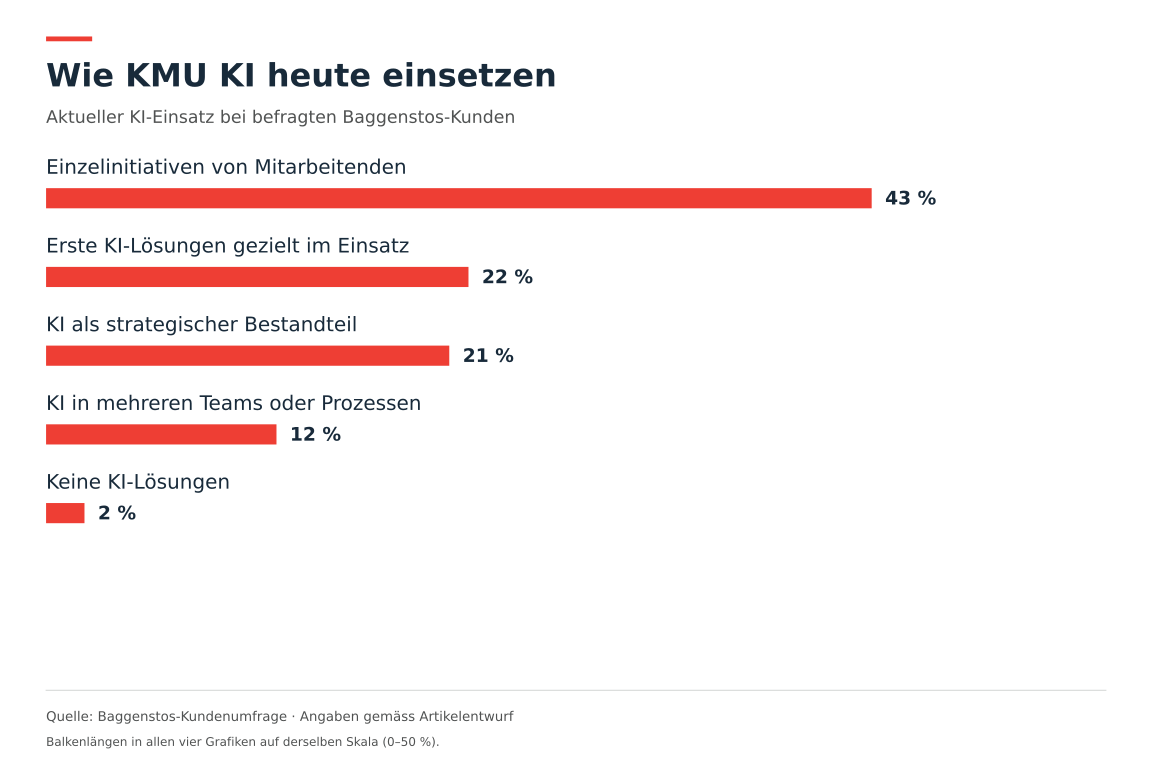
- 43% of the SMEs surveyed report individual initiatives by employees. 22% are using initial AI solutions in a targeted manner, and 12% are already using them across multiple teams or processes.
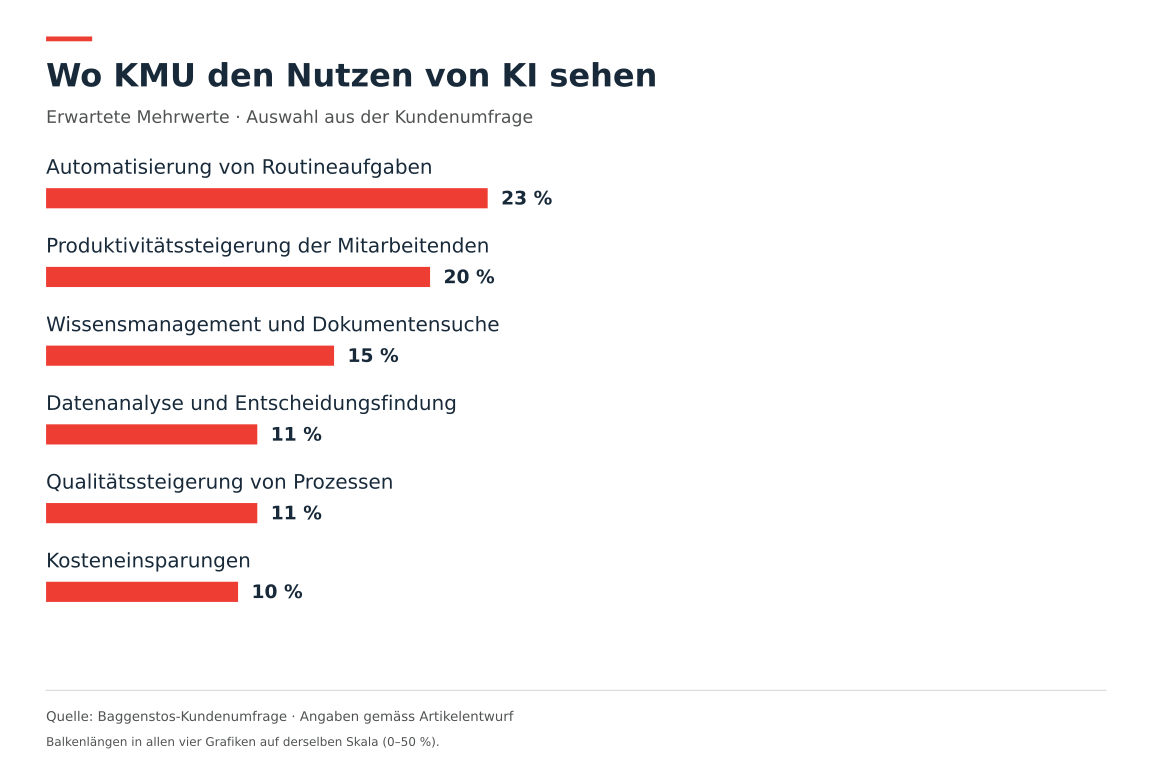
- Respondents expect the greatest benefits from the automation of routine tasks and increased productivity.
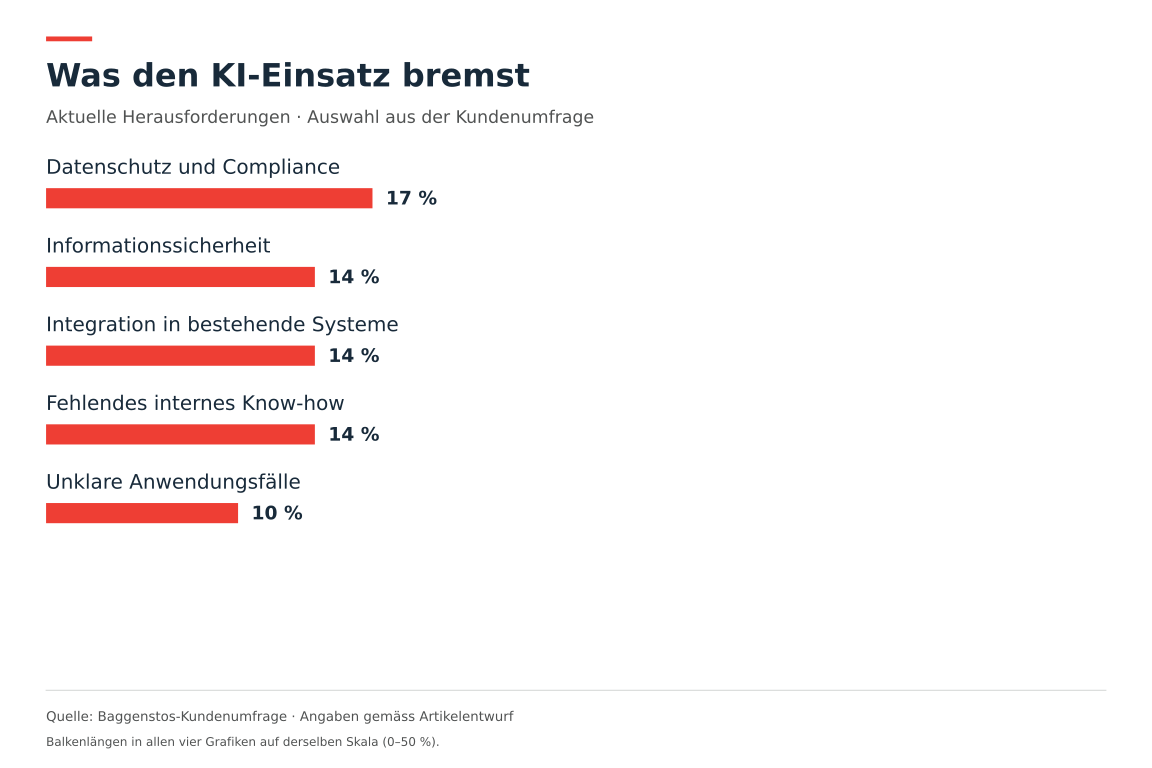
- Data protection, information security, integration into existing systems, and a lack of internal expertise are slowing down broader AI adoption.
Swiss SMEs are taking a pragmatic approach to AI and preparing for it conscientiously. This is the finding of a new survey among customers of the Swiss IT infrastructure provider Baggenstos, which specializes in Microsoft technologies. It paints a clear picture and "describes a trend for the entire SME landscape," says CSOIvo Gonzenbach. In summary:"Our SMEs are soberly focused on added value", he adds. The survey results align with experiences on the customer front and are reflected in projects and consultations with new clients."Microsoft Copilot is just the beginning."
From Individual Experiment to AI Strategy
The majority of SMEs are still in the early stages of AI adoption. While there is a great deal of openness, AI is often not yet used systematically, and a company-wide strategy is lacking. Technological questions are less of a priority, which suggests a fundamental trust in the technology. There is a need for clarification primarily regarding suitable business processes and use cases, data protection, risk assessment, and measurable benefits. Integration into existing systems also remains challenging for many.
At the same time, the companies surveyed have high expectations for this new digital workforce. They expect it to increase productivity (20%), automate repetitive tasks (23%), accelerate information retrieval (15%), analyze data more effectively (11%), and thus provide a better basis for decision-making. Notably, SMEs are no longer just concerned with texts or presentations. And it is not about cost savings either.
"They see the greatest economic benefit in the optimization of entire business processes,"says Baggenstos CEORenato Petrillo."At the same time, there is growing interest in AI agents, automation solutions, and data-driven decision-making processes."While the focus in the past was often on creating text or presentations, the emphasis has now shifted to optimizing entire business processes. This is precisely where the greatest economic value is currently being generated.
Data protection and security remain key hurdles
The survey also shows that data protection and information security are high priorities. The realization that uncontrolled use of AI carries significant risks has become widely accepted. Nevertheless, many SMEs still lack the necessary internal expertise. Furthermore, governance and security are currently essential components of the transition to an agentic workplace. Consequently, companies have primarily invested in AI readiness for the time being. The survey results suggest that SMEs are moving beyond theoretical discussions and are instead scrutinizing potential use cases and their added value."The era of experimentation is drawing to a close", says Renato Petrillo."Now, the phase of productive use is beginning."
SMEs need guidance
CSOIvo Gonzenbachdraws a conclusion from the customer survey:"The challenge in transforming traditional work environments into agentic ones lies primarily in uncovering hidden potential."SMEs cannot do this alone. They need a partner by their side who, based on experience with many other AI projects, knows how businesses can derive real value from AI implementation."Without compromising data protection and compliance", adds Gonzenbach.
Baggenstos' consulting and services therefore include a modular set of all elements required for AI implementation, from data labeling to Purview, from Copilot in all its forms to AI-driven security at the network and employee level.
Further links
Cloud Consulting Switzerland: Strategy, Architecture & Readiness Assessments for Companies
Microsoft Copilot for Business: Secure Implementation of Microsoft AI
Comprehensive compliance and data security with Microsoft Purview
Proactive protection against unknown cyberattacks with innovative Darktrace security
Key survey findings
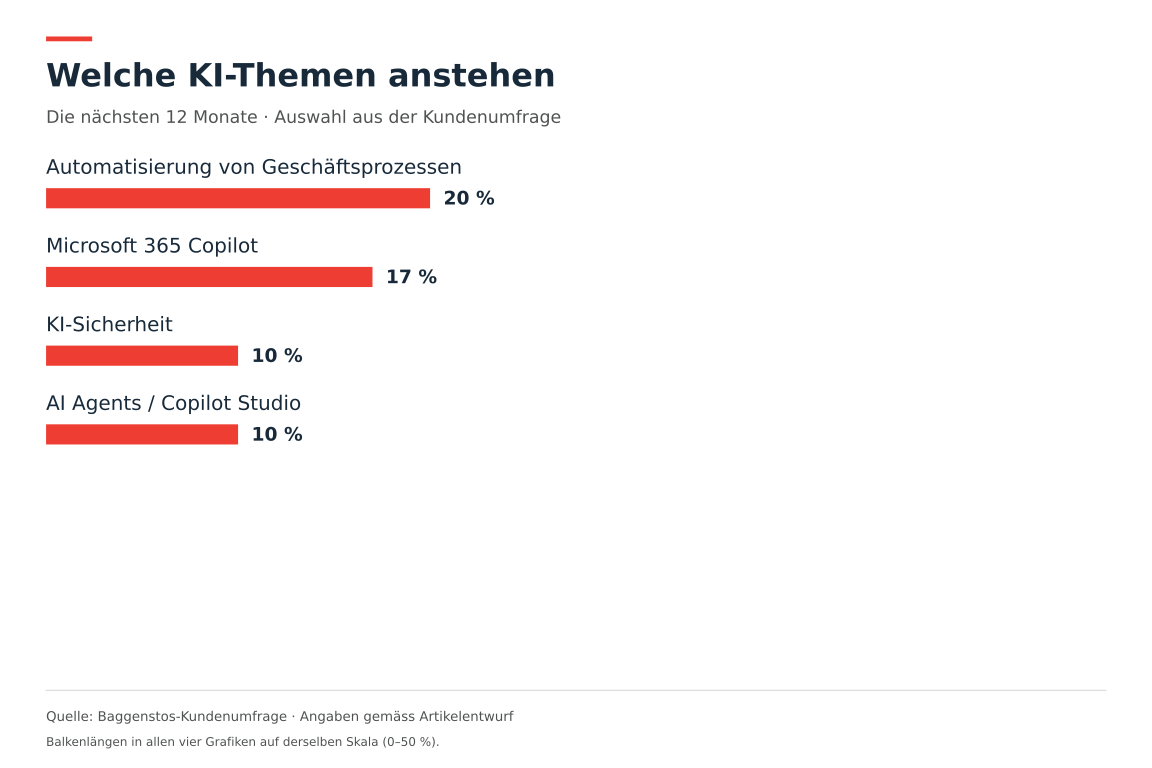
Responses from SME clients with 11 to 100 employees, along with a few larger and smaller firms, paint a picture of slow, pragmatic AI adoption.
Importance of AI over the next 12 months
On average, SMEs rate its importance at 3.64 out of 5 points
Frequently Asked Questions
Are customer data used to train the AI models?
No. Prompts and responses are not used to train the underlying language models and remain within the contractually guaranteed Microsoft 365 compliance boundaries.
Does Zero Trust also apply to AI agents?
Yes. Microsoft applies the same Zero Trust principles—such as explicit verification, least privilege access, and continuous monitoring—to AI agents via Entra ID, as these agents represent a distinct identity category that can also request access to corporate resources.
What does it take to successfully implement Copilot?
Beyond the technical setup, success requires active change management, clear organizational goals, cleaned-up access rights, and a phased licensing strategy, rather than relying on technology alone.
Is there a trial version of Copilot Business?
There is no trial version for the full Copilot Business license. However, you can try Copilot Chat at no additional cost with an eligible Microsoft 365 subscription.
What data can a Copilot Studio agent access?
In principle, only data that has been defined and authorized as a knowledge source during the agent's setup is used, in addition to the existing access rights of the respective user. Additional security measures for highly sensitive data can be implemented via Microsoft Purview.
How long does a Copilot implementation take?
This depends on the size of your company and the current state of your Microsoft 365 environment. A controlled pilot launch can often be implemented within a few weeks, while a company-wide rollout will take longer depending on the level of preparation.