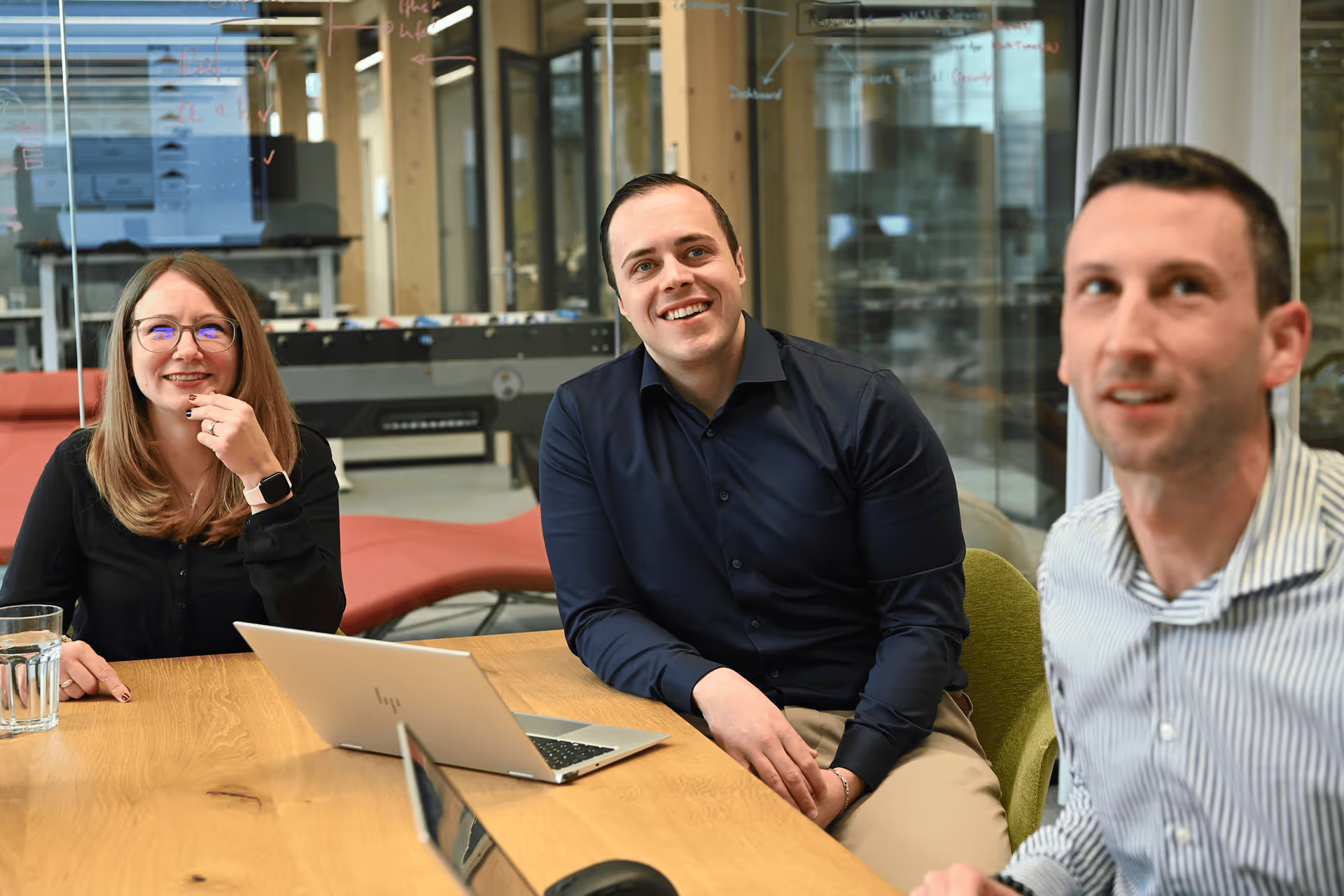
Saving food instead of maintaining servers. Tischlein deck dich migrates.
How the Swiss food-rescue association, together with Baggenstos, replaced its outdated remote environment with Azure Virtual Desktop in five months and connects 120 staff in a future-proof way.


The non-profit association Tischlein deck dich has operated an IT environment for many years that relied on software running in an RDS setup – using Remote Desktop Services to maintain and run applications remotely from various locations. A technology shift had now become unavoidable: Microsoft is discontinuing support for the RDS technology first introduced in 1998, along with its RDP protocol, which has become a popular target for hackers. At the same time, the Windows servers in use had grown too outdated to support the old environment going forward.
Modernising the Remote Environment
Working together, Baggenstos and the association migrated the line-of-business application within just five months to the future-proof Microsoft Azure Virtual Desktop (AVD) platform. AVD offers a more modern, secure and, above all, cloud-native approach to accessing centralised software remotely. It provides a unified interface offering desktops and applications across various Windows and Windows Server operating systems. This makes it possible to meet the infrastructure requirements of a volunteer-driven, decentralised organisation such as Tischlein deck dich.
Tischlein deck dich
For more than 25 years, the association Tischlein deck dich has rescued food from being destroyed and distributed it to people affected by poverty in Switzerland and the Principality of Liechtenstein. At over 160 distribution points and through additional food-aid initiatives, its staff reach people in need week after week. In 2024, they provided rescued food for around 2 million people. In doing so, Tischlein deck dich makes a valuable contribution to treating food with respect – in a way that is socially meaningful and ecologically sustainable.
{{Referenz (/tischlein-deck-dich-remote) | Alex Stähli}}
{{Referenz (/tischlein-deck-dich-remote) | Nicolas Huber}}
The Project at a Glance
Starting Point and Objective
The ageing and outdated RDS environment was to be replaced by Microsoft’s Azure Virtual Desktop (AVD) technology. Remote Desktop Services are of the utmost organisational importance for the decentrally organised association Tischlein deck dich.
Part of the brief was to leave the existing managed service unchanged and to replace only the remote environment during ongoing operations. An initial idea involving Domain Services, Windows 365 and Azure SQL – a serverless environment – had to be discarded because of an incompatible line-of-business application.
Key Figures
- Users and clients: 120
- Service Level Agreement in line with our Operation Care operating service for infrastructure and network
Solution and Implementation
The task required a thorough assessment to ensure the cutover went smoothly on the defined day. The Baggenstos specialists built a new Microsoft Azure Virtual Desktop (AVD) environment. In addition, the domain controller (DC) was rebuilt from scratch. The lengthy evaluation and testing phase proved valuable: the preparations were so precise that the cutover took place on the defined day without any problems.
Challenges
The software landscape of the association Tischlein deck dich is rather unconventional and includes a legacy line-of-business application that cannot be moved to the Azure cloud. A thorough assessment with a long preparation period leading up to the cutover day was required.
Results
With the new solution, staff can work without restrictions – location-independent and ready to go at short notice – and are equipped for future technological extensions. The organisation of this decentralised association with over 160 distribution points is simplified by the unified interface in the cloud, and staff are more productive today, whether at the head office in Winterthur, in the seven regional logistics warehouses, in the home office or at the association’s distribution points. This brings Tischlein deck dich closer to its goal of putting a stop to food waste and supporting disadvantaged people.
Why Baggenstos?
The collaboration with Baggenstos was characterised by dedicated and competent staff whose commitment was decisive in making the project a success. The project underlines Baggenstos’ expertise in delivering modern, future-proof IT solutions that are precisely tailored to customer needs.
Baggenstos supported us prudently throughout this IT project and, thanks to the seamless transition, continues to enjoy our complete trust to this day – which matters to us, because our core competence is rescuing food for people affected by poverty in Switzerland.
Alex Stähli
Managing Director, Tischlein deck dich

The project lasted five months, during which the Baggenstos team looked after us carefully and meticulously examined our unconventional IT environment.
Nicolas Huber
Head of Central Services, Tischlein deck dich
About
Mission & Impact
For more than 25 years, the association Tischlein deck dich has rescued food from being destroyed and distributed it to people affected by poverty in Switzerland and the Principality of Liechtenstein. At over 160 distribution points and through additional food-aid initiatives, its staff reach people in need week after week – in 2024, they provided food for around 2 million people.
Core Business
Logistics, distribution and organisation of rescued food. From the head office in Winterthur through seven regional logistics warehouses to the distribution points: the association coordinates a Switzerland-wide network – carried by salaried and volunteer staff alike.
What Makes It Special
Tischlein deck dich works in an extremely decentralised way. Its staff access central applications from the most varied locations – from the office in Winterthur through logistics warehouses to the home office. A stable remote environment is not a comfort but an organisational foundation.
IT Environment
120 users and clients, a line-of-business application with legacy characteristics, Remote Desktop Services as the central access point. The challenge: the existing RDS environment had reached the end of its technical life – and could not be lifted into the cloud one to one.
You might also be interested in